Kanlife
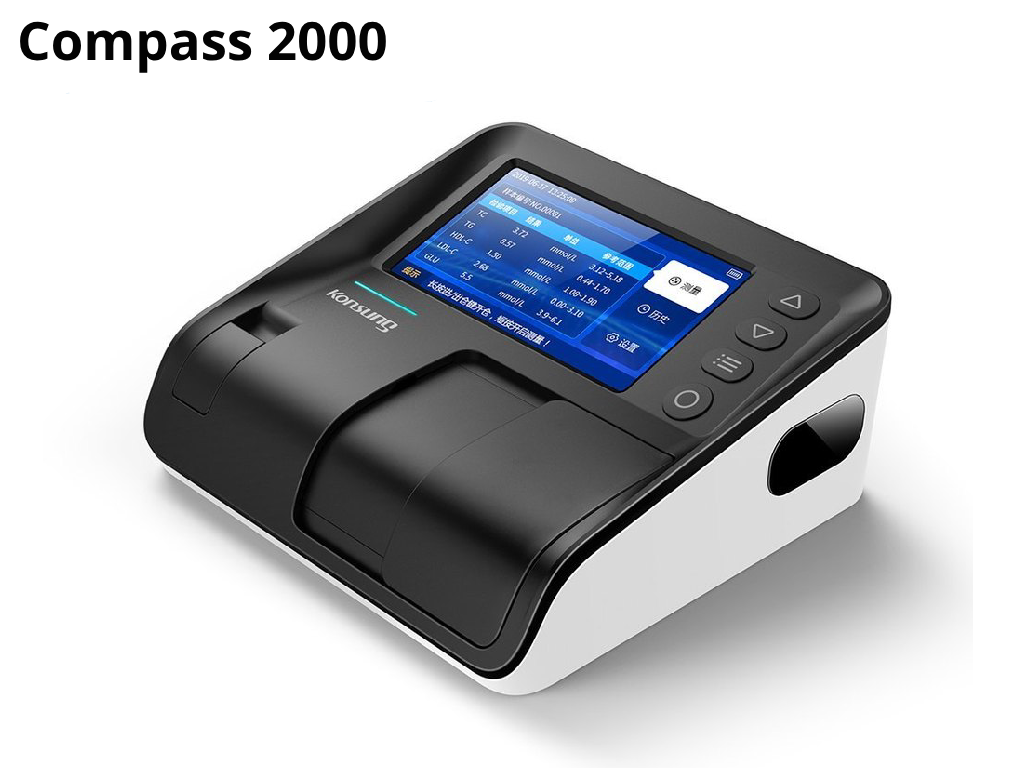
Compass 2000
Contact our team for pricing, configuration options and availability.
Thanks! Our team will contact you shortly.
The Compass 2000 Dry Biochemistry Analyzer from Kanlife is a portable, battery-operated point-of-care analyzer. Using single-use dry-chemistry test cards, it runs common biochemistry parameters — including liver function panels — from a small sample, with results in minutes at the point of care.
At a glance
- Portable and battery-operated — designed for camps, clinics and decentralised testing
- Dry-chemistry test cards; up to 12 biochemistry parameters on one analyzer
- Results in minutes from a small sample volume
- 4.3-inch touch screen and a built-in thermostatic control module
- Used with single-use Kanlife Dia card test cards (6 per pack)
The Compass 2000 is a point-of-care dry biochemistry analyzer, supplied in India by Kanlife. It is built for testing outside the central laboratory — primary care, clinics, health camps and community screening programmes — where a portable, self-contained analyzer is needed.
What is the Compass 2000 used for?
It runs common clinical-chemistry tests at the point of care using single-use dry-chemistry test cards. Panels include liver function tests, which supports the early identification of people who may have a liver disorder during screening initiatives, as well as other routine biochemistry parameters — up to twelve on a single analyzer.
Design for the point of care
Where it is used
Health-screening camps and outreach programmes, primary-care clinics, and any decentralised setting where sending samples to a laboratory would delay or lose the result. It is also a fit for pharma-supported preventive-health and early-detection initiatives.
Clinical context
Point-of-care biochemistry supports screening and clinical decision-making; abnormal results should be confirmed and followed up according to local pathways. Run quality control per the instructions for use.
Kanlife supplies the Compass 2000 with Dia card test cards, training and service support across India. Contact us for the parameter list and pricing.
Frequently asked questions
What tests does the Compass 2000 run?
Common point-of-care biochemistry parameters using dry-chemistry test cards, including liver function panels. Up to twelve parameters are available on the one analyzer — contact us for the current list.
How long does a test take?
Results are available in minutes from a small sample, so the patient can be given a result during the same visit rather than being referred to a laboratory.
Is it suitable for health camps?
Yes. It is portable and battery-operated with a built-in thermostatic control module, which is why it is used for camps, mobile clinics and community screening drives.
What consumables does it need?
Single-use Kanlife Dia card test cards, supplied six to a pack. A fresh card is used for each test.
Related products
Related reading
Liver/Hepatology
The Role of Non-Invasive Liver Fibrosis Assessment in Hepatology
This article discusses the importance of non-invasive liver fibrosis assessment in hepatology, focusing on techniques like FibroScan and their clinical applications.
Read article Liver/HepatologyHow Fibroscan Simplifies Non-Invasive Liver Assessment
Learn how Fibroscan technology is revolutionizing non-invasive liver assessment, providing accurate results without the need for invasive procedures.
Read article