How Fibroscan Simplifies Non-Invasive Liver Assessment
What is FibroScan and why it matters for liver assessment
FibroScan, made by Echosens, is the device most widely associated with non-invasive liver assessment worldwide. For a hepatology, gastroenterology or general-medicine practice in India, it answers a question that used to require a liver biopsy: how stiff and how fatty is this patient's liver, right now, without a needle. Kanlife Group distributes the full FibroScan range — the Mini 430, Compact 530 and 630 Expert — across India, so the right configuration for a decentralised clinic and for a high-volume hepatology centre are both genuinely available, not a one-size-fits-all import.
Liver disease is often silent in its early stages, which is exactly why a quick, repeatable, non-invasive assessment tool matters at the point of care — a patient can be screened during a routine consultation rather than referred elsewhere for an invasive procedure, which in practice means more patients actually get assessed rather than dropping out of the referral pathway. For a clinic, that also means a diagnostic capability that used to require referring patients out to a specialist biopsy service can instead be offered in-house, as part of the same visit.
How FibroScan works: VCTE explained
FibroScan uses Vibration-Controlled Transient Elastography (VCTE) — a probe placed against the skin over the liver sends a mechanical vibration into the tissue and measures how fast the resulting shear wave travels. A stiffer liver transmits that wave faster; the device converts this into a liver stiffness measurement in a few minutes, with the result available immediately, at the point of care. Alongside stiffness, the same probe captures Controlled Attenuation Parameter (CAP), which reflects how much fat is present in the liver — so a single FibroScan exam gives both a fibrosis signal and a steatosis (fatty liver) signal in one sitting, without sedation or preparation.
FibroScan versus liver biopsy
A liver biopsy samples a small core of tissue, which carries real procedural risks — bleeding, pain, and the possibility that the small sample doesn't represent the whole liver if disease is unevenly distributed. It also requires the patient to attend a procedure, often with some preparation and recovery time built around it. FibroScan instead assesses a much larger volume of liver tissue non-invasively, gives an immediate result, and can be repeated as often as a clinician needs — at follow-up visits, after a treatment change, or simply to track a chronic condition over months or years — without asking the patient to go through an invasive procedure each time.
Clinical applications across hepatology and gastroenterology
FibroScan is used to assess and monitor liver conditions including viral hepatitis, non-alcoholic/metabolic-associated fatty liver disease, alcohol-related liver disease, and cirrhosis. Because the exam is quick and repeatable, clinicians use it not just for an initial assessment but to track a patient's liver stiffness and fat content over time — across multiple visits — as a way of following disease progression or response to treatment, without repeated biopsies.
Patients commonly referred for a FibroScan assessment include those with known viral hepatitis, risk factors for fatty liver disease such as obesity, type 2 diabetes or metabolic syndrome, a history of heavy alcohol use, or simply persistently abnormal liver function test results that a clinician wants to investigate further before deciding on a biopsy or treatment pathway.
Choosing the right FibroScan model for your practice
Kanlife Group's three FibroScan models are built for different practice settings, not interchangeable versions of the same thing:
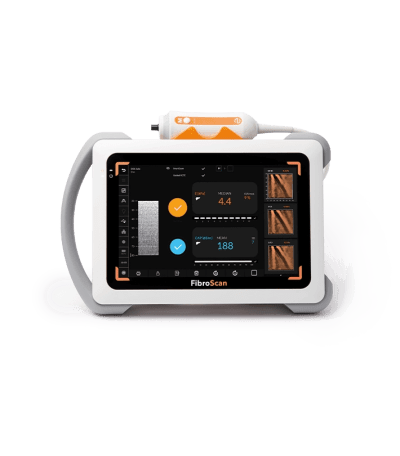
- FibroScan Mini 430 — a compact, portable form factor designed for primary care and decentralised clinics, where space and portability matter as much as the exam itself.
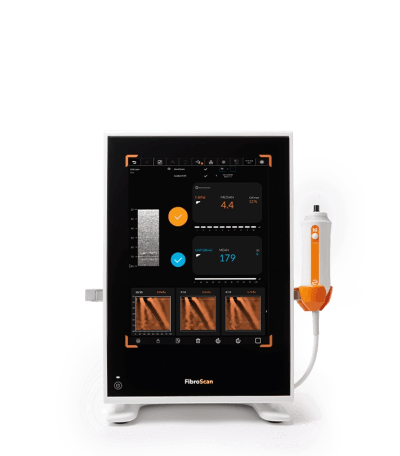
- FibroScan Compact 530 — a space-efficient console suited to outpatient hepatology and gastroenterology practices running a steady volume of exams.
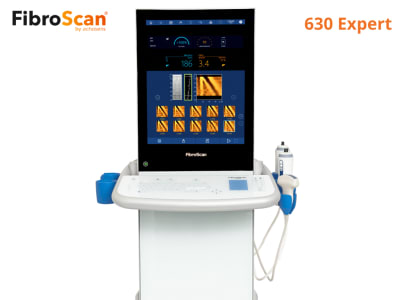
- FibroScan 630 Expert — the flagship console built for high-throughput hepatology centres seeing a large daily exam volume.
All three share the same core VCTE-plus-CAP measurement and immediate point-of-care results, and all are available with probe options covering a wide range of patient body habitus — the real differences are console throughput and footprint, which is what should drive the choice for your setting. A single-doctor primary-care clinic doing a handful of exams a week has a very different footprint and budget conversation than a tertiary hepatology centre running a full day of back-to-back assessments, and the right FibroScan model follows from that, not the other way around.
Fitting a FibroScan exam into clinic workflow
A FibroScan exam is performed by a trained operator with the patient lying down, and the result — both liver stiffness and CAP — is available within minutes, in the same consultation. There's no sedation, no incision, and typically no significant downtime for the patient afterward, which is part of why it fits into a routine outpatient visit rather than needing to be scheduled as a separate procedure day the way a biopsy would.
What to look for when buying a FibroScan device
Beyond the model itself, the questions worth asking a distributor are: what probe options are included for your typical patient population, what training and onboarding your team gets, and what after-sales service and maintenance support looks like once the device is in daily use. Probe choice matters in practice — a probe suited to a wider range of patient body habitus means fewer inconclusive exams, which is a real, practical procurement consideration rather than a nice-to-have.
It's also worth asking how quickly a replacement part or service visit can reach your location — for a device used daily in a busy outpatient clinic, downtime has a direct cost. Kanlife Group supplies genuine Echosens FibroScan equipment across India with installation support and after-sales service, backed by a PAN-India dealer network — not just a one-time hardware sale.
Clinical and diagnostic decisions should always follow your institution's protocols and the product's instructions for use.
Explore Kanlife Group's full FibroScan range — the Mini 430, Compact 530 and 630 Expert — or contact our team for a formal quotation and to discuss which configuration fits your practice.
Frequently asked questions
What is Fibroscan?
<p>Fibroscan is a non-invasive device, made by Echosens, that measures liver stiffness and fat content using ultrasound-based technology — without a biopsy.</p>
How does Fibroscan work?
<p>Fibroscan uses Vibration-Controlled Transient Elastography (VCTE): a probe sends a mechanical vibration into the liver and measures how fast the resulting wave travels, which indicates liver stiffness, alongside a Controlled Attenuation Parameter (CAP) reading for liver fat.</p>
What are the benefits of using Fibroscan?
<p>It's non-invasive, quick, and gives both a liver stiffness and liver fat (CAP) reading in one sitting, with results available immediately at the point of care — without sedation or preparation.</p>
Who can benefit from a Fibroscan assessment?
<p>Patients being assessed or monitored for liver conditions such as hepatitis, fatty liver disease and cirrhosis.</p>
Which FibroScan model is right for my clinic?
<p>The Mini 430 suits primary care and decentralised clinics where portability matters most, the Compact 530 suits a steady-volume outpatient hepatology/gastroenterology practice, and the 630 Expert is the flagship console for high-throughput hepatology centres. Contact Kanlife to discuss which fits your patient volume and setting.</p>
How do I get pricing for a FibroScan device in India?
<p>Contact Kanlife Group's team for a formal quotation — pricing depends on which model and configuration suits your practice.</p>