
Medtronic
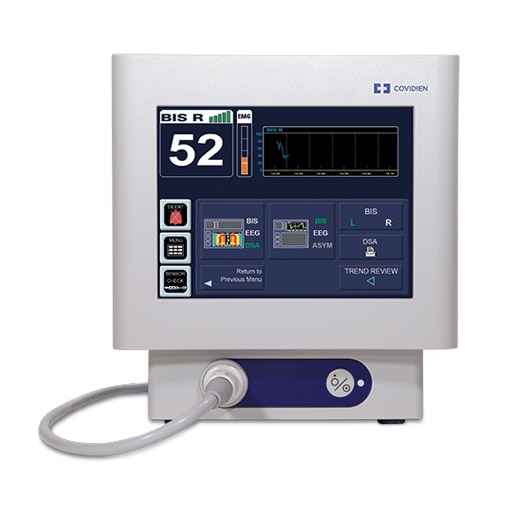
BIS 4 Channel Monitor | 186-1014
Contact our team for pricing, configuration options and availability.
Thanks! Our team will contact you shortly.
The Medtronic BIS 4-Channel Monitor is a processed-electroencephalogram (EEG) brain-function monitor used during general anaesthesia and sedation. It displays the Bispectral Index (BIS) — a 0–100 scale reflecting the hypnotic effect of anaesthetic agents — and supports a bilateral frontal montage for additional EEG data.
At a glance
- Bispectral Index (BIS): processed-EEG value on a 0–100 scale
- Four EEG channels — supports a bilateral / expanded frontal montage
- Displays EMG, Signal Quality Index (SQI) and Suppression Ratio (SR)
- Supports anaesthetic titration and assessment of hypnotic state
- Compatible with Medtronic BIS single-patient-use sensors
The BIS 4-Channel Monitor from Medtronic is a brain-function monitor that processes the frontal electroencephalogram (EEG) to help anaesthesia providers assess a patient's level of consciousness during general anaesthesia and sedation.
What is the Bispectral Index (BIS)?
BIS is a single, dimensionless number derived from the EEG and displayed on a scale of 0 to 100. A value near 100 corresponds to the awake state; lower values correspond to deeper hypnotic effect. A range in the region of 40–60 is commonly targeted for general anaesthesia, though the exact target is set by the anaesthesia provider according to the patient, the procedure and institutional protocol.
Why use four channels?
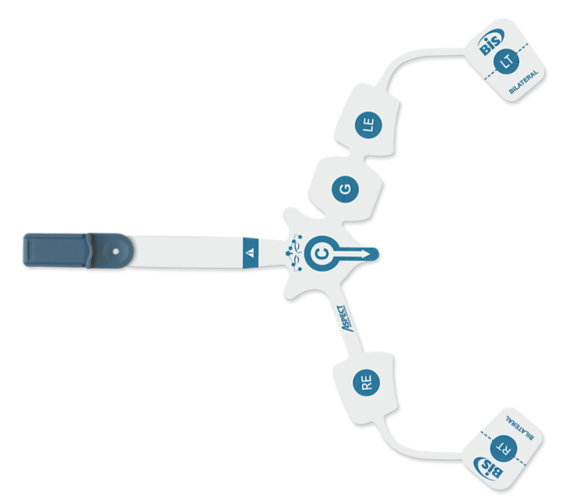
The 4-channel configuration supports a bilateral (left and right) frontal montage, for example with the BIS Bilateral sensor. Alongside the BIS number, the monitor displays supporting information such as the raw EEG waveform, electromyography (EMG) activity, the Signal Quality Index (SQI) and the Suppression Ratio (SR), which together help the clinician judge how much confidence to place in the reading.
Where it is used
- Operating theatres — general anaesthesia across a wide range of surgical specialties
- Intensive care — assessment of sedation depth in selected patients
- Procedural sedation outside theatre where processed-EEG monitoring is indicated
Clinical context
Processed-EEG monitoring is an adjunct to clinical judgement and standard anaesthesia monitoring, not a replacement for them. It has been associated with a reduced risk of intraoperative awareness with recall in at-risk patients and can support titration of anaesthetic agents. Readings can be affected by EMG, electrical interference, certain drugs and neurological conditions.
Kanlife supplies Medtronic BIS monitoring with installation, training and sensor supply across India. Contact us for configuration and pricing.
Frequently asked questions
What does a BIS monitor measure?
It processes the frontal EEG and reports the Bispectral Index, a 0–100 value that reflects the hypnotic (sedative) effect of anaesthetic agents on the brain. It does not measure analgesia or muscle relaxation.
What BIS value is used for general anaesthesia?
A range around 40–60 is commonly cited for general anaesthesia, but the target is chosen by the anaesthesia provider for the individual patient and procedure and according to institutional protocol.
What is the advantage of the 4-channel version?
Four channels support a bilateral frontal montage, providing EEG information from both hemispheres in addition to the BIS number, EMG, signal quality and suppression ratio.
Which sensors does it use?
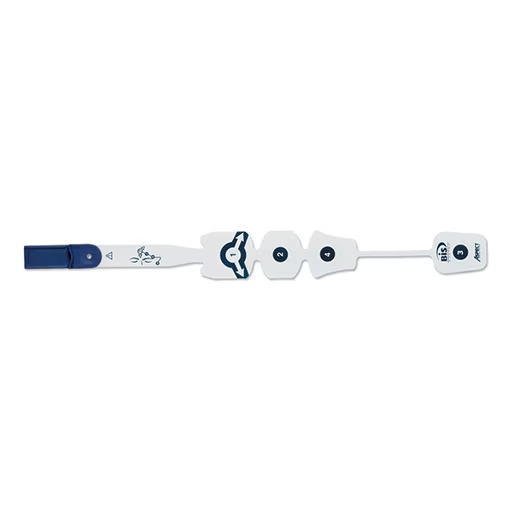
It works with Medtronic BIS single-patient-use sensors, including the BIS Quatro and BIS Bilateral sensors. Sensor choice depends on the montage and the clinical setting.
Does BIS monitoring replace standard anaesthesia monitoring?
No. It is an adjunct to clinical assessment and to standard monitoring (ECG, SpO2, capnography, blood pressure and so on), not a substitute for them.
Related products

Related reading
Anesthesia
Understanding BIS Cerebral Monitoring in Anesthesia
BIS cerebral monitoring is a vital tool in anesthesia that enhances patient safety by accurately assessing the depth of anesthesia.
Read article AnesthesiaAdvancements in Anesthesia Monitoring: How New Technologies Enhance Patient Safety
Explore how advancements in anesthesia monitoring technologies are crucial for enhancing patient safety during surgical procedures.
Read article