Skanray
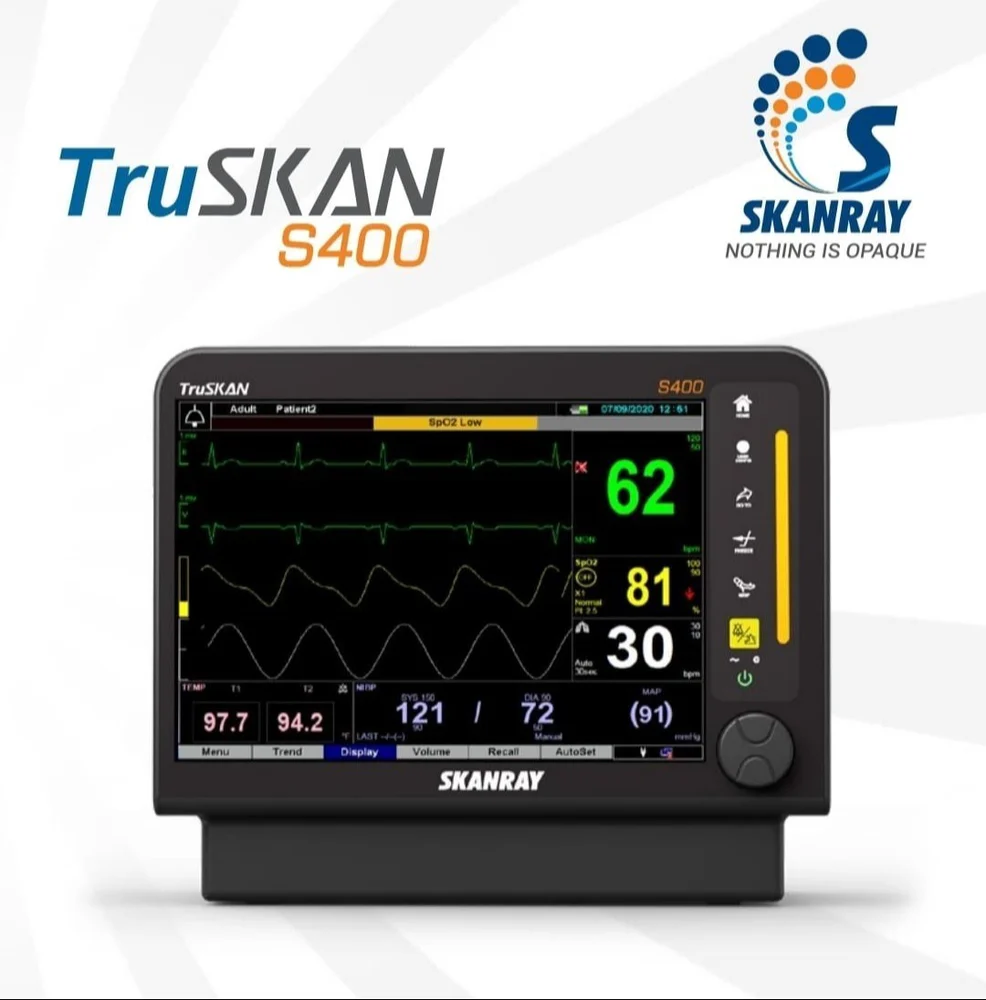
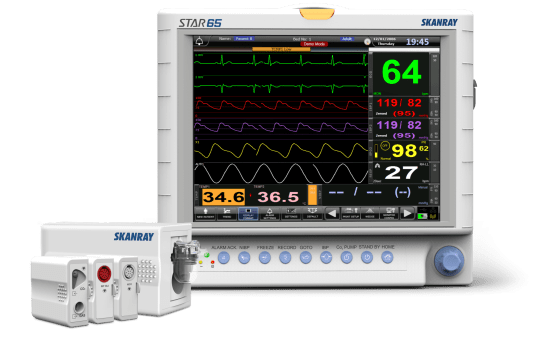
Patient Monitor System S-400
Contact our team for pricing, configuration options and availability.
Thanks! Our team will contact you shortly.
- Comprehensive monitoring: ECG, Respiration, Dual Temperature, NIBP, Dual IBP, SpO2 & micro stream EtCO2
- User-configurable layout with multiple layout selections
At a glance
- 10.4" display with comprehensive monitoring: ECG, Respiration, dual Temperature, NIBP, dual IBP, SpO2 and microstream EtCO2
- User-configurable screen layouts to match clinical workflow
- SatSeconds, LoSat and IPI for early warning of desaturation
- ST-segment and arrhythmia analysis included as standard
- Wired and wireless networking to Skanray's Central Nursing Station, with HL7-based HIS support
- 168 hours of vital-signs trend storage with fast-access keys and optical encoder navigation
- Advanced features like SatSeconds™, LoSat™ & IPI™
- Networking Capabilities: Wired & wireless connectivity to Skanray’s Central Nursing Station
- Support for HL7-based interfacing with HIS
- Vital Trends & Storage of 168 hours
- Seamless navigation through fast access keys and optical encoder control
- ST segment analysis and arrhythmia analysis as standard
Frequently asked questions
What parameters does the S-400 monitor?
It provides comprehensive monitoring of ECG, respiration, dual temperature, NIBP, dual IBP, SpO2 and microstream EtCO2 on a single screen.
Is the monitor suitable for different patient types?
Yes, it is designed to monitor adult, paediatric and neonatal patients.
How much patient history can it store?
It stores vital-sign trends for up to 168 hours, letting clinicians review a patient's recent course.
Can it be networked with other monitors or the hospital system?
Yes, it supports wired and wireless connectivity to Skanray's Central Nursing Station and HL7-based interfacing with a Hospital Information System (HIS).
How is the monitor operated?
It uses fast-access keys and an optical encoder for quick navigation, alongside a user-configurable display layout.
Does it support early detection of patient deterioration?
Yes, advanced features like SatSeconds, LoSat and IPI, along with ST-segment and arrhythmia analysis, help flag early signs of deterioration.
Related products
Related reading
Anesthesia
Advancements in Non-Invasive Monitoring Techniques for Pediatric Anesthesia
Explore the latest advancements in non-invasive monitoring techniques that enhance patient safety during pediatric anesthesia procedures.
Read article AnesthesiaAdvancements in Anesthesia Monitoring: How New Technologies Enhance Patient Safety
Explore how advancements in anesthesia monitoring technologies are crucial for enhancing patient safety during surgical procedures.
Read article