Skanray
Skan Revive | Defibrillator
Contact our team for pricing, configuration options and availability.
Thanks! Our team will contact you shortly.
- Synchronized cardioversion
- 3L/5L ECG support
At a glance
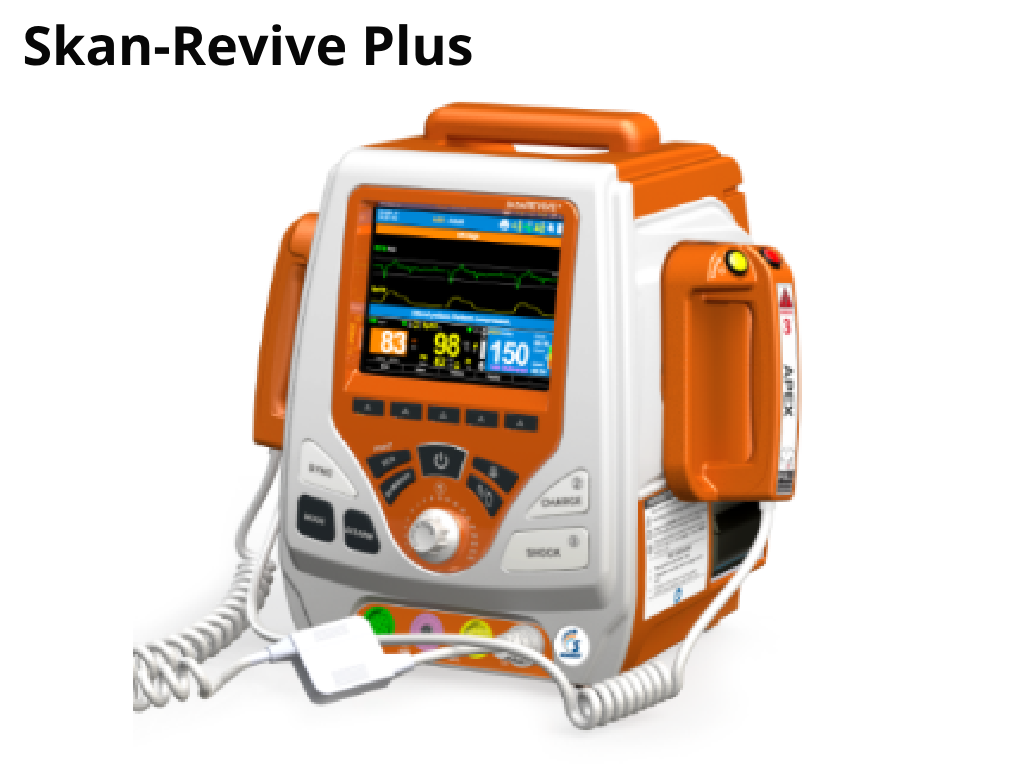
- Biphasic defibrillation with a current-controlled, time-limited waveform and patient impedance compensation
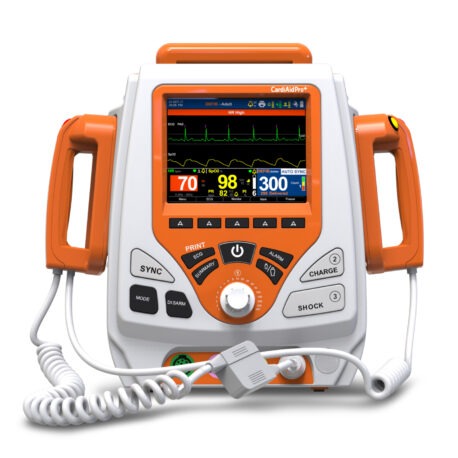
- Synchronized cardioversion plus 3-lead/5-lead ECG support
- Charges up to 300J in less than 8 seconds for rapid response
- More than 100 shocks available from a single fully charged battery
- Quick energy selection via a simple rotary switch
- 6.5" colour LED display with a built-in thermal printer for data storage and event summaries
- Less than 8 seconds to charge upto 300J
- More than 100 shocks from a new fully charged battery
- Quick energy selection option via rotary switch
- Data storage & event summary
- 6.5” Colour LED display
- Built-in thermal printer
Frequently asked questions
What is the Skan Revive defibrillator used for?
It is a biphasic defibrillator used in hospitals and emergency settings to deliver an electrical shock that can restore normal heart rhythm during life-threatening cardiac arrhythmias.
Does it support synchronized cardioversion?
Yes, it offers synchronized cardioversion in addition to standard defibrillation, along with 3-lead/5-lead ECG support.
How fast can it charge for a shock?
It charges up to 300 joules in less than 8 seconds, supporting rapid response in an emergency.
How many shocks can one battery charge deliver?
A new, fully charged battery can deliver more than 100 shocks.
Can event data be reviewed after use?
Yes, the device stores event data and includes a built-in thermal printer to produce event summaries for clinical review.
Is training required to operate this defibrillator?
Yes, it should be operated by clinically trained staff familiar with defibrillation protocols and ECG interpretation.
Related products