
Medtronic
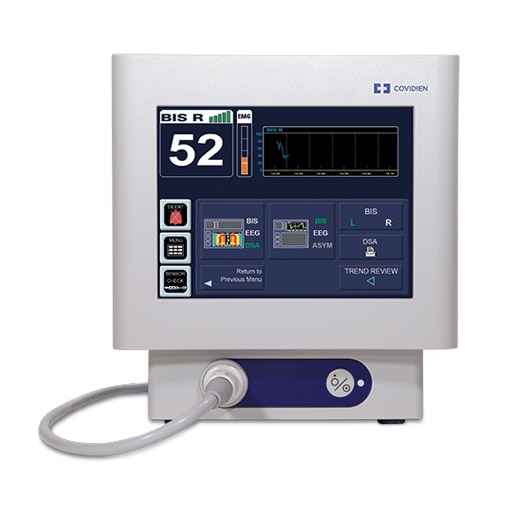
BIS 2 Channel Monitor | 186-0210
Contact our team for pricing, configuration options and availability.
Thanks! Our team will contact you shortly.
Bispectral Index™ (BIS™) Monitoring System
Part Number / CFN: 186-0210
The BIS™ Monitoring System is a cutting-edge solution designed to provide healthcare professionals with a direct measurement of a patient’s level of consciousness during surgery. By offering precise insights into the effects of anesthesia on the brain, this system helps enhance patient safety and optimize anesthetic management.
Advanced 2-Channel Monitor for Anesthetic Depth Monitoring
The BIS™ Monitoring System comes with state-of-the-art 3.5 software, offering a complete anesthetic depth monitoring solution. It accurately interprets brain activity to support effective anesthesia administration, ensuring optimal patient outcomes.
At a glance
- Real-time BIS index tracks anesthetic depth from processed EEG signals
- Density Spectral Array (DSA) and Spectral Edge Frequency (SEF) visualize brain-wave trends
- Suppression Time and Suppression Ratio flag possible isoelectric (flatline) EEG states
- User-configurable display adapts to different clinical workflows
- Supports individualized anesthetic dosing to help avoid over- or under-sedation
- Versatile, upgradeable platform built for evolving anesthetic-depth monitoring needs
Why Choose BIS™ Technology?
- Proven Algorithm: The BIS™ technology utilizes a trusted algorithm to deliver reliable and actionable insights into the anesthetic effects on each patient’s brain.
- Personalized Anesthesia Management: Too much or too little anesthesia can lead to complications like longer recovery times and postoperative neurocognitive disorders. BIS™ technology allows you to tailor dosing, improving emergence and recovery times.
- Up to 38% Less Anesthetic Use: Efficiently manage anesthetic agents, reducing usage by up to 38%.
- Faster Patient Recovery: Patients monitored with BIS™ technology have demonstrated 27–53% faster wake-up times in the operating room.
- Reduced Postoperative Delirium: Experience up to a 29% reduction in postoperative delirium, enhancing overall patient well-being.
Key Features of the BIS™ Complete 2-Channel Monitors
The BIS™ Monitor translates raw EEG data into an easy-to-read BIS™ index, offering healthcare providers a clear picture of the patient's brain activity. Key features include:
- Density Spectral Array (DSA): Visual representation of EEG bands, providing comprehensive data analysis.
- Spectral Edge Frequency (SEF): Accurate measurement of EEG activity to monitor anesthetic depth.
- Median Frequency (MF): Detailed brain activity analysis for informed decision-making.
- Suppression Time (ST) & Suppression Ratio (SR): Track and evaluate the impact of anesthesia on brain activity.
- User-Configurable Display: Customize the monitor display to suit specific clinical needs and preferences.
Future-Ready Versatile Platform
The BIS™ Monitoring System is designed to be a versatile platform, allowing for future expandability and adaptability to meet the evolving demands of anesthetic monitoring.
Enhance Anesthesia Management with BIS™ Technology
Incorporating the BIS™ Monitoring System into your clinical practice can significantly enhance patient care and improve anesthesia management. With its reliable insights and proven technology, the BIS™ system is a trusted choice for healthcare professionals aiming to optimize surgical outcomes.
Frequently asked questions
What does the BIS 2 Channel Monitor measure?
It provides a direct, real-time measurement of a patient's level of consciousness during surgery by interpreting processed EEG signals into a BIS index.
What part number is this monitor?
This is the BIS™ 2-Channel Monitor, Part Number / CFN 186-0210.
How does BIS technology help anesthesia management?
It supports personalized anesthetic dosing — associated clinical data shows up to 38% less anesthetic use and 27–53% faster wake-up times.
What EEG parameters does the monitor display?
It displays Density Spectral Array (DSA), Spectral Edge Frequency (SEF), Median Frequency (MF), and Suppression Time/Ratio (ST/SR).
Can the display be customized?
Yes, the monitor has a user-configurable display to suit specific clinical needs.
Is this platform expandable for future use?
Yes, it is designed as a versatile, upgradeable platform for evolving anesthetic-depth monitoring needs.
Related products

Related reading
Anesthesia
Understanding BIS Cerebral Monitoring in Anesthesia
BIS cerebral monitoring is a vital tool in anesthesia that enhances patient safety by accurately assessing the depth of anesthesia.
Read article AnesthesiaAdvancements in Non-Invasive Monitoring Techniques for Pediatric Anesthesia
Explore the latest advancements in non-invasive monitoring techniques that enhance patient safety during pediatric anesthesia procedures.
Read article